Climant Impact - Closing the biomethane loop: what Southeast Asia’s emerging biomethane market means for offtakers
14 Sept 2026 | 8 minutes reading
Closing the biomethane loop: what Southeast Asia’s emerging biomethane market means for offtakers
Summary: Biomethane is not new. The region's biomethane industry has grown steadily for decades and is now poised to take off as momentum builds across the ecosystem due to converging regulatory and commercial pressures.
Overview: Southeast Asia’s biomethane market is emerging, catalysed by growing demand due to converging regulatory and commercial pressures. As the market develops, attention is shifting towards the practical requirements needed to scale supply: feedstock aggregation, infrastructure development, cross-border coordination, certification system, and commercial framework across the value chain. For offtakers, the opportunity now hinges on early action: mapping feedstock at the ground level, building supply chains resilient to seasonality and logistics, and aligning on traceability for sustainability claims. Those who act early will be best placed to secure reliable, credible biomethane supply as the ecosystem matures.
Growing demand for biomethane / bioLNG
In Southeast Asia, biomethane generated from agricultural and municipal waste has historically been used largely for on-site electricity and heat generation, often as raw biogas rather than upgraded biomethane1. However, that model is beginning to change. Converging regulatory and commercial pressures are creating demand for biomethane as a desirable clean energy commodity, tradeable across borders. Biomethane demand in Southeast Asia, together with import demand from Japan and South Korea, is forecast to grow to roughly 55 TWh by 20402.
Key drivers of biomethane / bioLNG demand
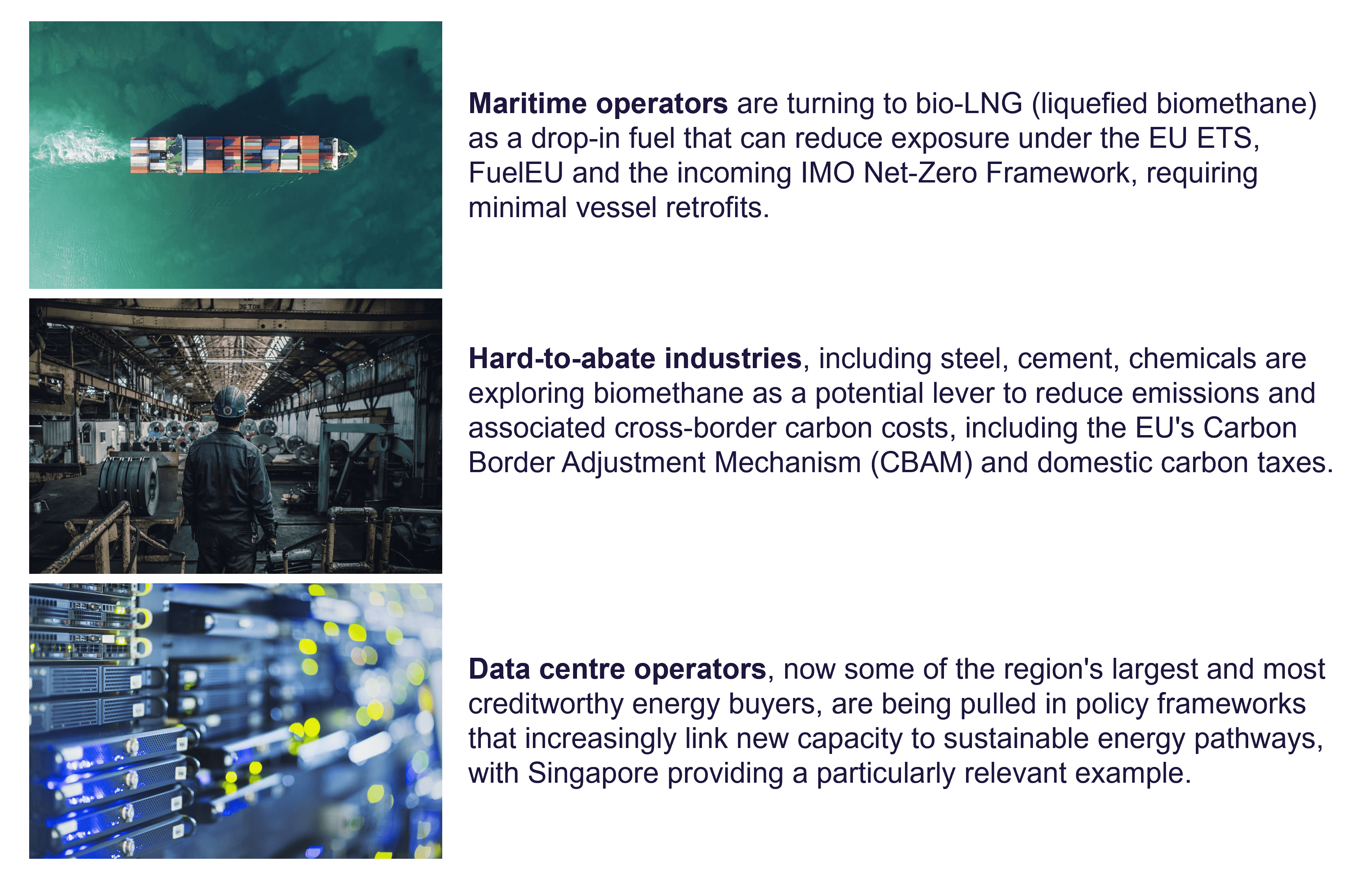
In light of this emerging demand, three buyer groups have
been increasing in relevance.
Let's bring your climate and clean energy goals to life together.
Tap to enlarge
Compared to alternatives, biomethane
carries an inherent advantage over other sources as it is a drop-in fuel, usable with minimal retrofit to existing power plant, and unlike intermittent
renewable sources such as solar and wind, it can deliver firm baseload energy
while providing diversification of clean supply.
Yet actual production tells a different story. Despite the
abundance of resources in this region, whereby the effluent from the palm oil
industry in Indonesia and Malaysia alone could generate
an estimated 100 – 290 TWh2 of biomethane a year, the region's biomethane output sits at
only around 8 TWh2 today. The central challenge is therefore not simply
resource availability or technology. It is whether Southeast Asia can build the
commercial, infrastructure and certification ecosystem required to turn
fragmented resources into reliable, tradeable supply.
Establishing the ecosystem: challenges & opportunities
Despite the scale of the opportunity, several structural barriers continue to constrain the development of a scalable biomethane market in the region:
Supply is fragmented, aggregation is needed for commercial-scale
offtake
EnlargeTap to enlarge
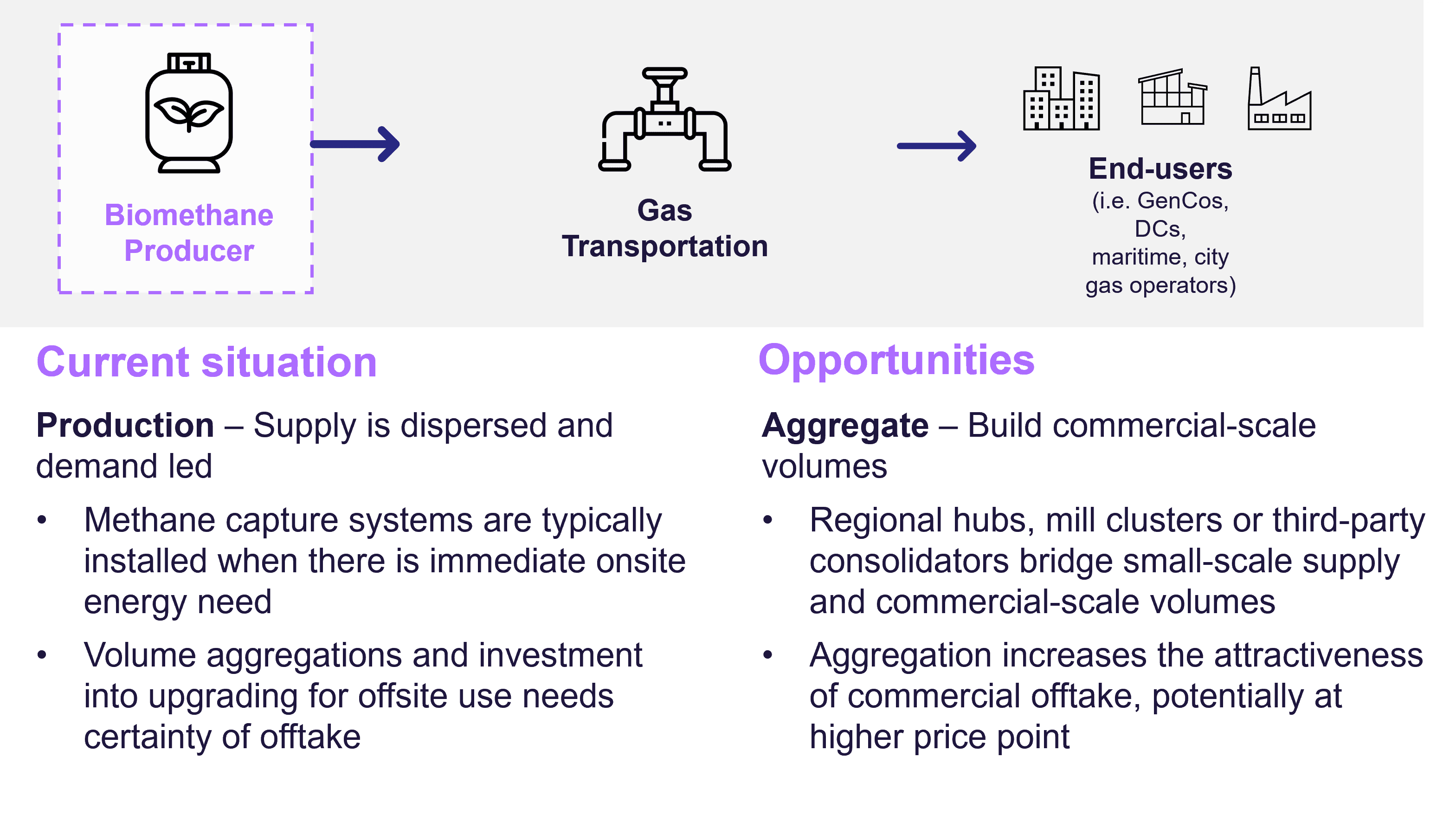
On the supply side, there has not been a consistent business case to justify investment in Palm Oil Mill Effluent (POME) methane capture and upgrading the biogas, without sufficient certainty of offtake. Most methane capture systems are only installed where there is immediate onsite energy need in the form of biogas, usually without upgrading.
Consolidating volume for offsite consumption, either for domestic consumption or cross-border export, may offer alternative utilisation pathways; however, the infrastructure gap to consolidate supply volume remains. Unlike biogas/biomethane facilities in Europe, India and China, where centralised facilities dedicated for biomethane production can typically produce 500,000 – 600,000 MMBTU per year of biomethane3, the typical output of a single mill is only a fraction of that, i.e., 75,000 – 130,000 MMBTU per year. Centralised treatment and upgrading could provide the scale needed to access offsite markets, potentially at higher price points; however, mill proximity, inter-mill connectivity, ownership and commercial models will need to be assessed.
Aggregating feedstock across mills – through
regional hubs, mill clusters, or third-party consolidators – could help bridge
the gap between fragmented, small-scale production and the volumes needed for commercial
offtake. This would require a commercial model that allocates the costs and
risks of consolidation across multiple mill owners, potentially anchored by
long-term offtake commitments that de-risk the initial investment in capture, upgrading
and transportation infrastructure.
Biomethane transportation involves multiple parties, close coordination
is crucial to reduce friction
EnlargeTap to enlarge
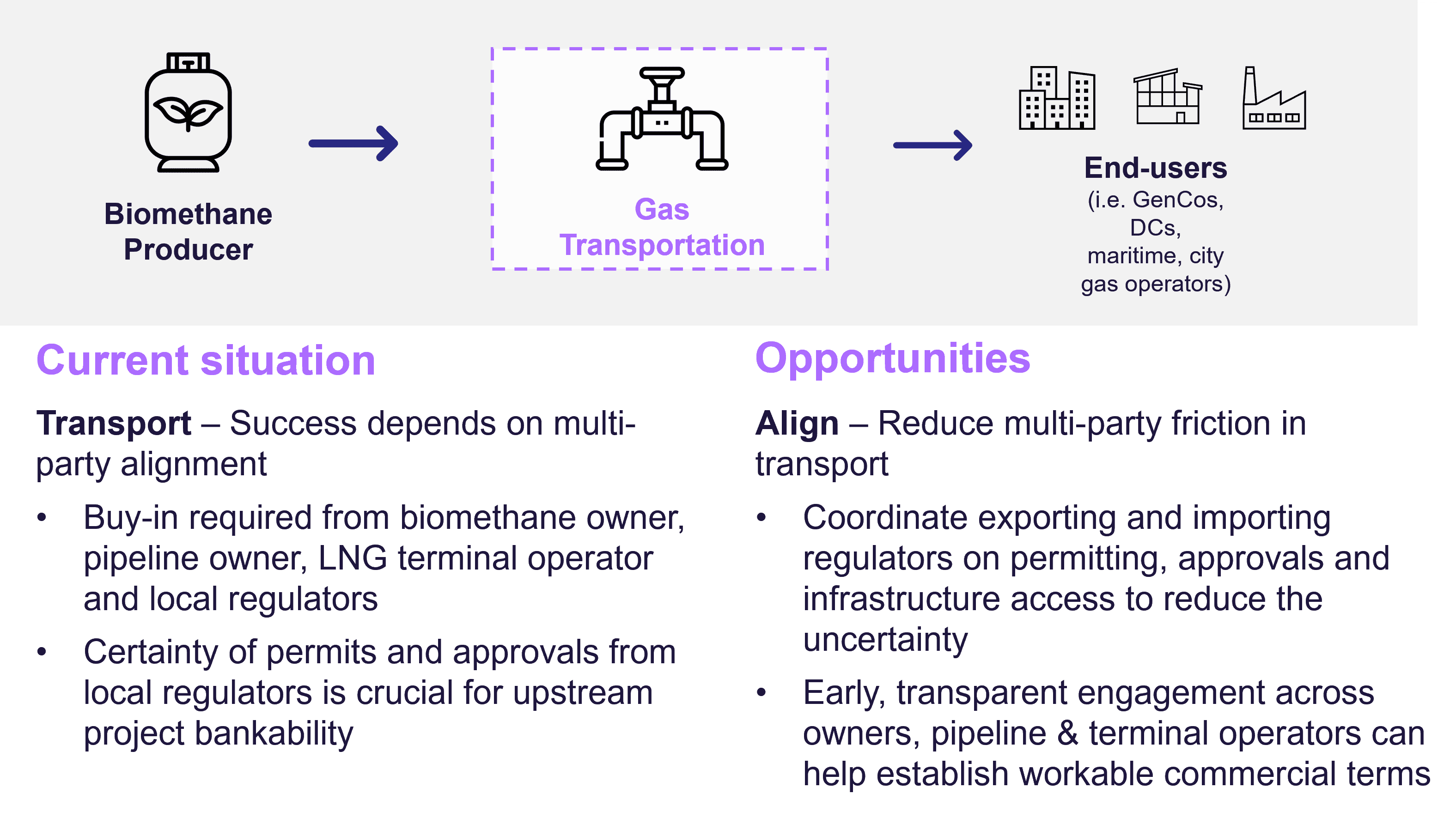
Transporting the biomethane molecule from where it is produced to where it is consumed requires active involvement across various stakeholders, e.g., the biomethane owner, pipeline owner, and LNG terminal operator – especially when cross-border import and export are involved. While technically feasible, this means that key stakeholders must ensure there is the right level of commercial and operational coordination to drive these initiatives. The lack of clarity from local regulators regarding permits and approvals further adds to the uncertainties that affect upstream project bankability.
Closer coordination between regulators in exporting and importing
countries – on permitting, approvals, and infrastructure
access – would reduce the uncertainty that
currently weighs on project bankability. Early, transparent engagement between
biomethane owners, pipeline operators, terminal operators, and offtakers can also help establish workable
commercial arrangements before projects reach a final
investment decision.
Credible certification framework is imperative for integrity but
also needs to reflect regional realities
EnlargeTap to enlarge
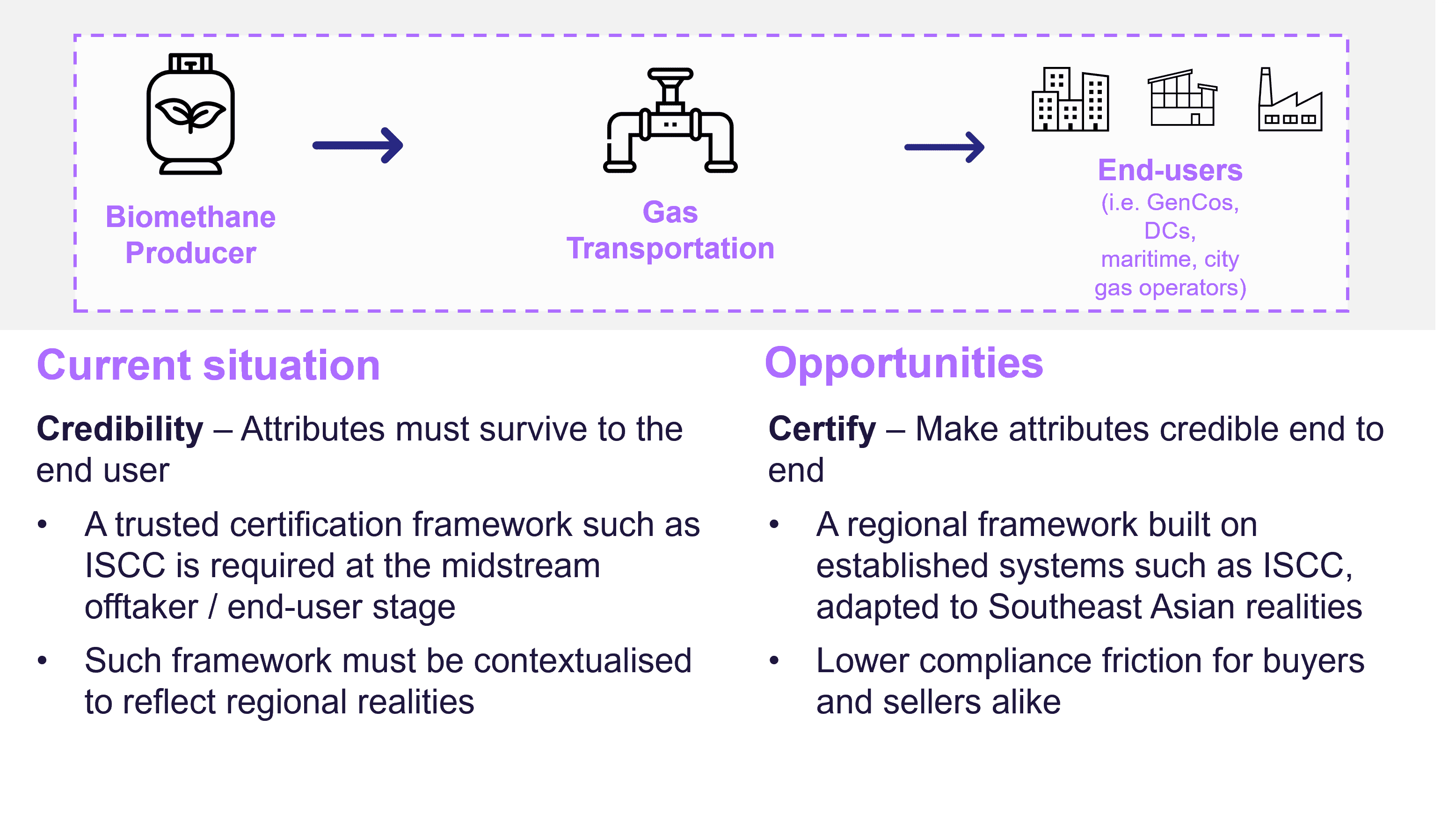
In addition to the complexity of cross-border import and export of biomethane, cross-border trade also requires a trusted system that defines how environmental attributes are measured, verified and traded. The widely recognised ISCC framework provides a good foundation for traceability, chain of custody management and greenhouse gas accounting; however, it may not reflect regional realities, e.g., region-specific feedstock, cross-border supply chains, and domestic policy objectives. It is crucial to get a greater regional alignment on certification and traceability that reduces compliance friction and accelerates the development of scalable biomethane and bio-LNG supply chains, while maintaining global credibility.
Greater regional alignment (e.g. regional-specific
frameworks) – built on the credibility of established systems like ISCC but
adapted to reflect Southeast Asia's specific feedstock, supply chains, and
policy context – would reduce compliance friction for buyers and sellers alike.
This could be pursued through industry-government collaboration, ensuring any
regional approach maintains global recognition
while remaining practical to implement on the ground.
These challenges, and the measures needed to address them, apply to every buyer segment, whether the offtaker is a data centre operator, a shipping line, or an industrial exporter. What differs is how each sector is being pulled into the market, and by what mechanism. Singapore's data centre sector offers a useful case study in how this is playing out in practice.
What does this mean for biomethane offtakers?
The case study of DC operators
With the recent announcement of DC-CFA24 winners, Generation Companies (GenCos) are now working with DC operators – as part of the Biomethane Regulatory Sandbox – to deliver biomethane-generated electricity under the DC operators’ proposed Eligible Green Pathways by 2029. While the Sandbox gives GenCos a lower-risk environment in which to secure biomethane supply, i.e., through demand aggregation and a supportive regulatory framework, the DC operators’ commitment to undertaking pathfinding efforts alongside GenCos to bring biomethane molecules into Singapore is what is needed to adequately match supply with demand.
However, bringing the biomethane molecule to market and commercialising its value is complex, particularly given how nascent this development is in the region. In a fragmented agri-waste supply chain, offtake and supply agreements are only as strong as what happens on the ground. Seasonality, quality variation, supply chain concentration, and shifting price dynamics can all undermine supply security and delivery reliability. The robustness of the MRV system will also bear directly on the integrity of the environmental attributes being transacted.
It is therefore important for DC operators to work closely with GenCos to establish appropriate risk allocation and commercially sound contractual arrangements. Derisking measures including diversification of supply, ground-level feedstock mapping to assess long-term volume and quality, pre-treatment and logistics design around seasonal and operational realities, and certification aligned with green attribute traceability and sustainability reporting requirements, should be addressed early in the negotiation process, rather than left until later. At the same time, care should be taken not to overengineer these arrangements, to ensure the resulting structure remains practical and sustainable to implement for both parties.
The same considerations apply
for shipping lines, industry players and gas operators
The same principles that DC operators and GenCos are now working through, i.e., early risk allocation, feedstock derisking, and robust traceability, will increasingly apply to other emerging biomethane offtakers and sectors. For example, maritime players should be preparing now, with MPA's September 2026 award of eight new LNG bunkering licences requiring low-carbon LNG and biomethane readiness from day one5; industrial exporters facing mounting CBAM and carbon tax exposure should begin assessing biomethane as a bankable, traceable supply and secure supply, if relevant, in advance of potential compliance obligations. As Japan and South Korea emerge as major biomethane and bio-LNG import markets6, Southeast Asian producers and their offtakers should start building the certification rigour needed to compete for that demand.
What do biomethane offtakers need to do now?
Actions to prioritise in
the short-term
The window for early movers is beginning to narrow. Several projects and long-term contracts are already targeting initial bio-LNG deliveries to Singapore from 20276, with early volumes likely to be shaped by bilateral and long-term offtake arrangements. Prospective offtakers should begin positioning themselves now. This includes:
Mapping regulatory and carbon exposure. Offtakers should identify where regulatory requirements and carbon costs could strengthen the business case for biomethane, including CBAM, FuelEU, IMO requirements, or DC-CFA2 commitments, and prioritise the use cases where biomethane offers the greatest strategic and commercial value.
Engaging upstream suppliers and midstream players directly, rather than waiting for a mature market to form. As the market is globalising faster than its regulatory architecture, credible counterparties and bankable projects are still being identified. Early conversations shape which projects get built and who gets the first call on how supply and commercial structures develop.
Conducting feedstock and counterparty due diligence upfront. Given that high capital costs, lengthy permitting procedures, infrastructure-access limitations, local infrastructure deficits and difficulties aggregating feedstock continue to slow project development, offtakers should stress-test feedstock availability and sustainability, project delivery timelines, infrastructure dependencies and counterparty capability before committing.
Negotiating flexible, realistic contract structures. As the biomethane ecosystem in the region is still nascent, offtake agreements signed today should build in mechanisms to adapt as regulatory requirements, certification standards and supply conditions evolve.
Begin long-term planning
to secure competitive advantage that compounds over time
Looking further ahead, offtakers that succeed in this market will be those who move beyond securing any supply to securing the right supply on the right terms: diversifying across producers, feedstocks and geographies to manage concentration risk; considering direct investment in midstream consolidation and upgrading infrastructure to strengthen supply security; and helping shape and harmonise regional certification approaches as they emerge. The biomethane market's future scale will be determined by the industry's ability to convert abundant resources into reliable, tradable supply. For offtakers, the advantage will lie with those who engage early and deliberately to secure the right supply on the right terms.
At Climant Impact, we help organisations navigate their clean fuel sourcing journey – from assessing waste valorisation strategies and its business cases, to identifying waste value creation pathways, providing biomethane contracting advisory support, and conducting operational due diligence to derisk investment decisions.
Notes:
Biogas is the raw gas consisting of 50 – 75% methane, 25 – 50% of carbon dioxide prior to upgrading to biomethane
Source: BCG, 2026. Asia-Pacific is the new frontier of biomethane investment
Malaysia's biogas capture take-off traces back to the Feed-in Tariff introduced under the Renewable Energy Act 2011, administered by SEDA; more than a decade on, however, only around 170 of the country's roughly 450 palm oil mills have installed biogas facilities7, with grid connectivity and proximity to transmission infrastructure remaining a key constraint on wider rollout
Source: Straits Bio-LNG’s presentation at AgriWaste to Value conference, Jakarta, July 2026
Redefining Emissions: What the GHGP Scope 2 Revisions Mean for Your Business and Carbon Accounting
The GHGP’s Scope 2 update is set to redefine how companies measure and claim clean energy. This article explains these changes and outlines practical steps organisations can take to strengthen credibility and minimise their compliance burden.
 Enlarge